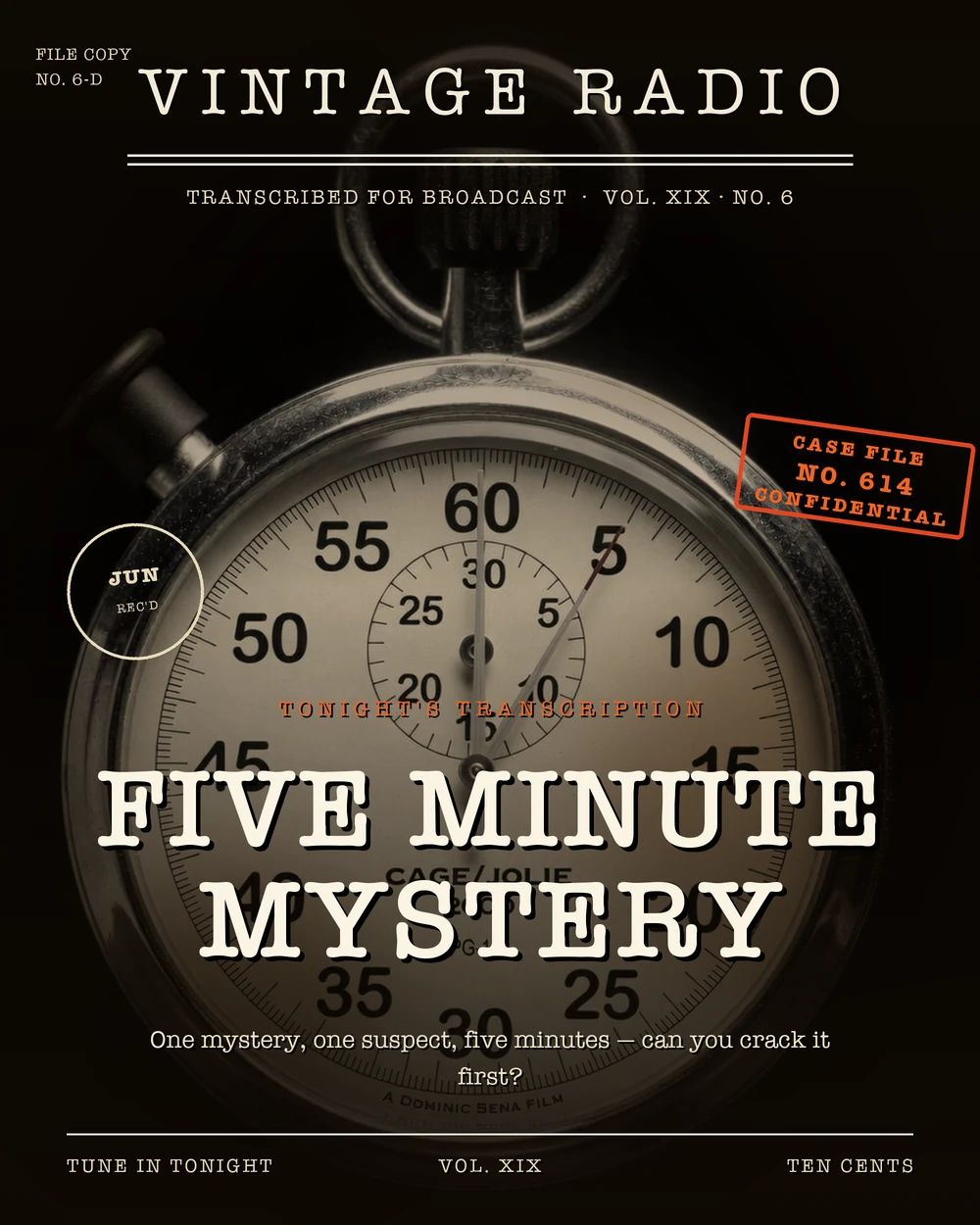
Five Minute Mystery
The Shortest Detective Show in Radio
Most radio mystery programs gave their detectives half an hour to close a case, sometimes fifteen minutes if the format was tight. Five Minute Mystery gave its detective roughly two minutes of airtime to arrive at a crime scene, take in the evidence, and announce a solution — with a pause built in so the listener could try to beat him to the answer. That's the whole show. What's remarkable isn't that someone thought of this format, but that it actually worked.
The setup was trim and consistent. Each episode opened with about half a minute of organ music, followed by an announcer's introduction, then a brief radio play in which a detective or police officer arrived at the scene of a sudden crime. All the clues the audience needed to solve the case were laid out in plain sight. Then the organ music came back in, giving the listener a minute to think before the final reveal. The whole thing was over before most programs had finished their opening theme.
How It Got on the Air
Five Minute Mystery was a syndicated transcription series distributed by NBC/RCA, with episodes pressed onto vinyl discs and shipped to local radio stations for use as filler. If a sports broadcast ended early, or a gap opened up in the schedule, a station could drop in a five-minute mystery and fill the hole neatly. This wasn't the prestige end of network radio, but it was a practical format that served a real programming need.
There appear to have been at least two syndicated runs — one around 1940 and another running roughly from 1945 to 1948. Surviving discs carry matrix numbers pointing to recording dates in late 1947, which fits the later run. NBC reportedly produced around 296 episodes in total across the syndicated series, though most episode information — writer credits, actor credits, original air dates — has been lost over the decades. OTR researchers have identified approximately 96 episodes with enough documentation to catalog them, which matches the episode count available today.
The show was distributed as a barter program, meaning local stations could use it to sell advertising to local merchants or trade the ad spots for goods and services. To make local customization easy, producers built musical interludes into each episode — specifically the organ passages — so a local announcer could step in with an advertiser's message, then hand back to the drama. Some stations went further, having local advertisers offer prizes to the first caller who phoned in the correct solution. The organ music, provided throughout by organist Rosa Rio, served both dramatic and commercial purposes at once.
The Cast and What's Known About It
Actor credits weren't given on the individual episodes, which was common practice for syndicated transcription programs of this type. What's known about the cast has largely been pieced together by researchers after the fact. Jackson Beck, a prolific New York-based radio performer best known as the announcer on The Adventures of Superman and as the voice of Bluto in the Popeye cartoons, was a regular performer on the syndicated series from around 1946. Other names associated with the MBS-era archive releases include Staats Cotsworth, Michael Fitzmaurice, Timmy Hyler, Abby Lewis, Frank Lovejoy, and Ian MacAllister. Lovejoy's voice, distinctive enough to stand out, has been identified by researchers on several early episodes even without formal credits to confirm it.
At least one script survives — "Murder on the Set," authored by writer Alvin Boretz — which is one of the few pieces of direct documentation on how these episodes were actually written. Given that the format demanded a complete dramatic arc, a set of fair-play clues, and a satisfying resolution inside two minutes of airtime, tight scripting wasn't a luxury; it was the whole job.
The Puzzle at the Center
The key mechanic of Five Minute Mystery was its invitation to the audience. Every clue needed to solve the crime was given to the listener. The detective wasn't working with information the audience didn't have — there were no hidden revelations saved for the final moment. The listener was expected to work the puzzle alongside the detective and, ideally, arrive at the answer before the solution was announced.
This put the show in company with interactive mystery formats like Ellery Queen's Minute Mysteries, which ran a similar concept. One difference: Five Minute Mystery's syndicated version offered no prizes. Solving the mystery was its own reward. The local-station versions sometimes added cash prizes or goods supplied by local advertisers, but the base format made no such promise. It was a puzzle for the pleasure of puzzling.
Episode titles from the catalog give a sense of what the cases looked like: "Dr. Brown's Poisioned Wife," "Machinery Factory Murder," "Lord Duncan Murdered," "Horse Stable Murder," "Gas Station Shooting," "Fiance Murder Case," "Man Dies in Cave," "Jules Buck Murder." The crimes ranged widely in setting and circumstance, but the shape of each episode was the same — a body, a scene, a set of observable facts, and a solution that followed logically from what had been presented.
The Mutual Version and the Bigger Picture
Running alongside the syndicated five-minute format was a related but distinct program on the Mutual Broadcasting System. The Five Mysteries Program aired on MBS from August 10, 1947 to March 27, 1950, with Sunday afternoon broadcasts at 2 p.m. during 1947 and 1948. Where the syndicated Five Minute Mystery was a solo listening puzzle, the MBS program expanded the concept into a 30-minute format featuring five dramatized mini-mysteries per episode, with solutions discussed by a studio panel.
On the MBS version, panelists — sometimes listeners, sometimes guests drawn from a relevant professional background — suggested solutions and earned five dollars for correct answers. A 1949 edition used gas industry officials as the amateur sleuth panel, which gives some sense of how the show was assembled week to week. The two programs shared a concept but operated as separate productions for different audiences and different formats.
Five Minute Mystery isn't as widely remembered as Suspense, Box 13, or the other mystery programs it shares shelf space with. That isn't surprising — it was designed as filler, distributed without credits, and consumed in five-minute increments by audiences who probably didn't know or much care what they were listening to between the end of a ballgame and the next scheduled program. What it represents is an experiment in compression: how much of a detective story's essential machinery — the crime, the clues, the deduction, the reveal — could survive being squeezed into five minutes? Ninety-six surviving episodes suggest the answer was: more than you might expect.